
Ready for any compliance requirement.
Every framework asks for the same four things: enforced controls, evidence, an inventory, and documented policy — and Brutor produces all four on every call, with the evidence born at the enforcement point. SOC 2, the EU AI Act, HIPAA, GDPR, and ISO/IEC 42001 are wired in with first-class tags; the same machinery answers whatever your auditor asks next.
One registry answers the first question: what AI are you running?
The AI Asset Registry lists every model, MCP server, and agent your company uses — and every asset carries a fact sheet: how much it was used, which guardrails fired, what was blocked. The inventory an auditor asks for on day one, maintained as a byproduct of running the platform.
- Models, tools, agents — governed and observed assets in one inventory, each with ownership and usage attached
- Fact sheets per asset — usage volume, guardrail invocations, blocked requests, in auditor-readable form
- Imported assets included — models observed through vendor analytics sync into the same registry with their own fact sheets
Enable a framework once — every decision tags itself.
Turn on the frameworks you follow in the admin console. From then on, every request gets its proxy log tagged at the moment a control fires — down to the specific criterion: SOC 2 tags carry CC numbers, EU AI Act tags carry the risk tier you set per resource group, GDPR tags mark identifiable-PII processing events. Frameworks compose freely — enable several and each row is stamped with every applicable tag, searchable from every angle, never duplicated. A guardrail block isn’t just a block; it’s a tagged, timestamped line of evidence.
request   POST /v1/proxy/llm · surface chat_output · resource group sales
guardrail pii_detection → REDACTED (email, IBAN)
tags      soc2.cc6.6 · eu_ai_act.high · iso_42001
evidence  date-scoped CSV export per regime — built for the auditor’s hands
This is the page’s whole argument in one record: the control fired, the data was redacted, and the evidence tagged itself to your frameworks — no quarterly evidence-gathering project required.
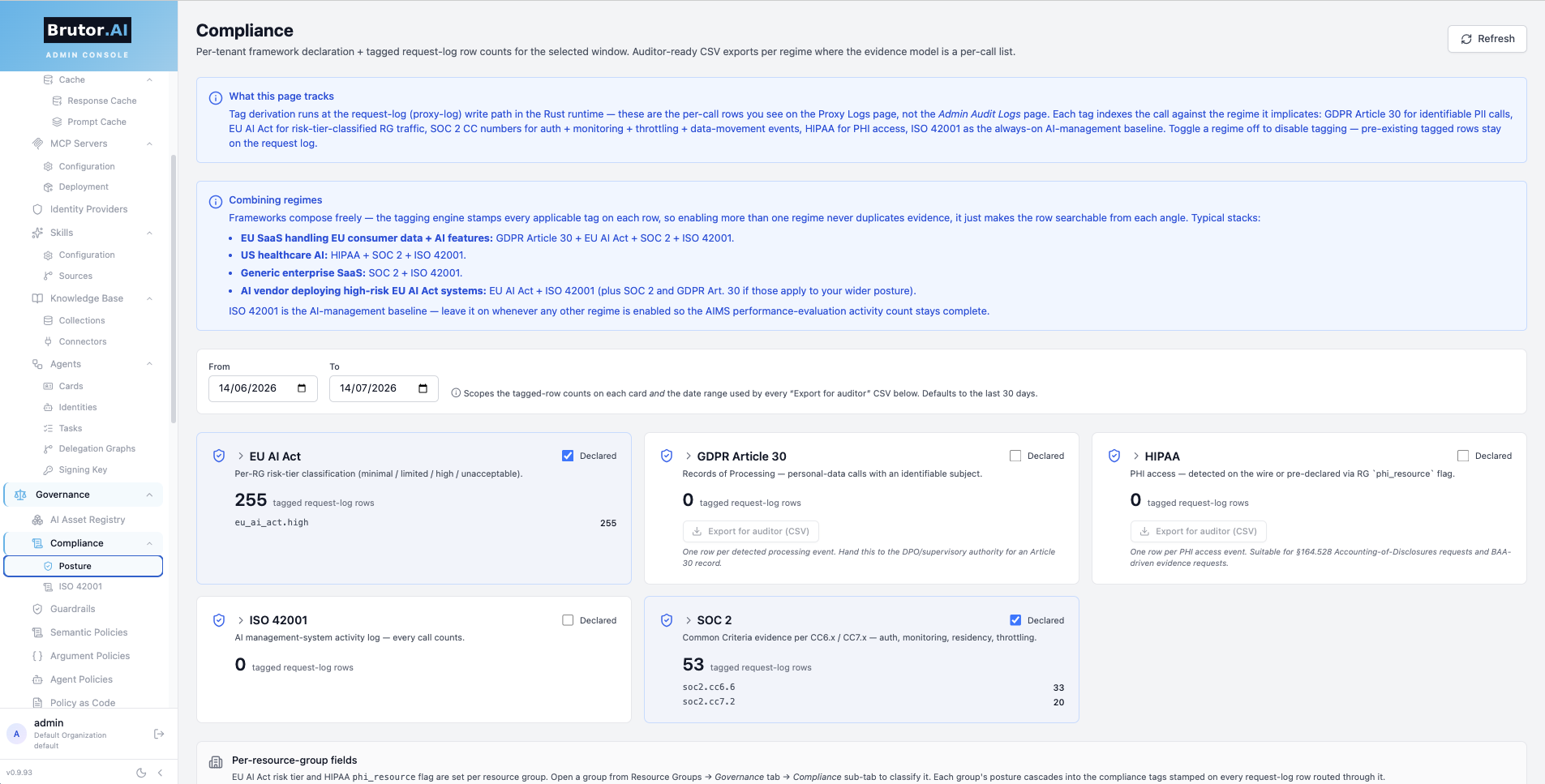
The posture view in the admin console: declared frameworks, tagged-row counts for any date window, and an “Export for auditor” CSV per regime.
Four layers of control — every decision becomes a record.
Evidence is only as good as the enforcement that produces it. Four control layers run in the request path, each scoped by resource group — give sales a stricter configuration than engineering — and each writing tagged audit lines as it works.
Guardrails
PII (email, SSN, IBAN, cards), prompt injection, secrets (AWS keys, GitHub tokens), toxic content — on chat input and output, blocked or redacted. Extend with external providers like Microsoft Presidio for deeper PII and named-entity detection.
chat_output → pii → redactSemantic policies
For what pattern-matching misses: write the constraint in natural language and a judge model checks every request — run it in shadow mode first, then enforce.
“block customer PII exfiltration” · judge: haiku-4.5Argument policies
Syntax-aware control of tool calls: analyzers for SQL, URLs, shell commands, file paths, and JSON parse the actual arguments — a destructive query is refused even when the text looks harmless.
query_sales_db → sql → deny non-read, deny multi-statementAgent policies
Per-agent capability grants: your billing bot may call models and read sales data, is denied delete_customer with a 403, and waits for human approval before generating the report.
allow · deny · approval required (human-in-the-loop)Your entire governance posture, in version control.
Everything above — guardrails, policies, approvals, framework settings — exports as YAML. Lock it down per resource group, check it into GitHub, and review governance changes the way you review code: as diffs, with history, with owners. This is also why a new compliance requirement doesn’t start a project: the controls exist, the evidence is already flowing, and meeting the new rule is a configuration change with a commit history.
# governance export — resource group: sales (excerpt)
guardrails:
  - surface: chat_output
    checks: [pii]
    action: redact
policies:
  - type: argument
    tool: query_sales_db
    analyzer: sql
    rules: [read_only, single_statement]
  - type: semantic
    name: block-customer-pii-exfiltration
    action: enforce
An auditor asking “what changed, and who approved it?” gets a Git history, not a shrug.
Guidance, not just tagging.
Frameworks are opt-in per tenant — enable what you actually follow, and stack them: an EU SaaS handling consumer data typically runs GDPR Article 30 + EU AI Act + SOC 2 + ISO 42001; US healthcare AI runs HIPAA + SOC 2 + ISO 42001; the enterprise baseline is SOC 2 + ISO 42001. Keep ISO 42001 on whenever anything else is enabled — it’s the AI-management baseline the others sit on.
SOC 2
The default starting point for US-market companies — your customers’ security teams ask for it first. Evidence tags carry the Common Criteria number (auth, monitoring, throttling, data movement), so a row doesn’t just say “SOC 2” — it says which criterion it satisfies.
EU AI Act
Enable it if you sell into the EU. Set the risk tier per resource group — minimal, limited, high — and every routed call inherits the classification in its tag. GPAI enforcement is already underway; the high-risk wave lands December 2027, and the runtime evidence you start collecting now is the preparation.
ISO/IEC 42001
More than tagging: a built-in readiness tracker — a Statement of Applicability covering 38 controls across the standard’s clauses, some satisfied automatically by platform activity (your resource documentation is the registry itself), with per-clause coverage and a one-click evidence pack for the auditor.
HIPAA & GDPR
Working evidence for regulated data: GDPR tagging writes one row per detected processing event — the raw material of an Article 30 record for your DPO — and HIPAA tagging tracks PHI access per call, the shape accounting-of-disclosures requests and BAA evidence asks for.
Following something else — sector rules, an internal AI policy, a customer’s security questionnaire? The same machinery answers: enforced controls in the request path, tagged and exportable evidence, the asset inventory, and your governance posture as reviewable code.
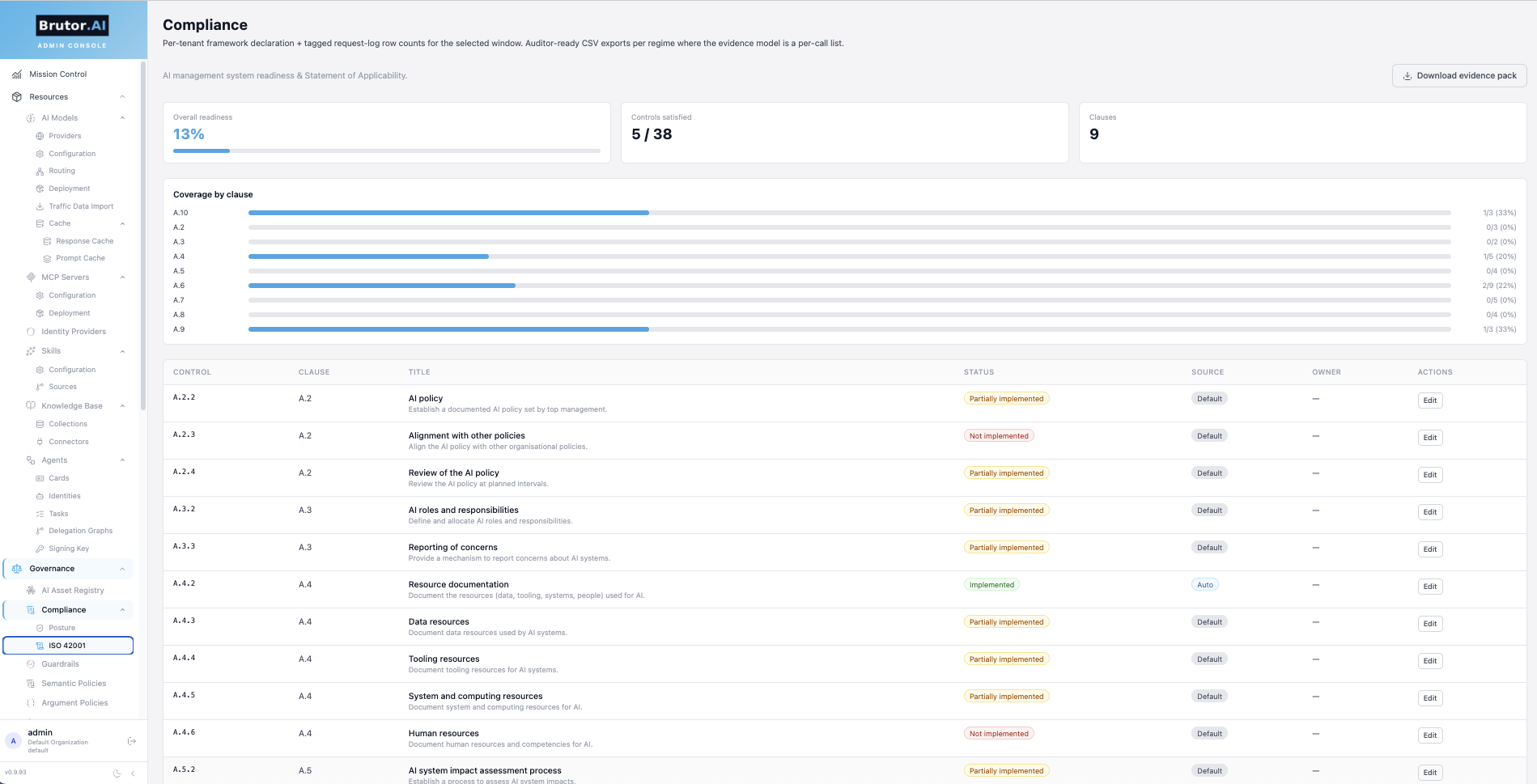
Evidence and tagging cover every framework — for ISO 42001 we go further and guide your progress. The console tracks readiness control by control across the standard’s 38 controls: what’s implemented, what’s partial, what’s left — some satisfied automatically by platform activity — with the proof bundled into a one-click evidence pack.
Evidence is generated where enforcement happens: on traffic that routes through the gateway. AI you use outside the gateway appears in the registry as observed assets with usage-based fact sheets — inventoried and costed, clearly marked as observed.
Walk into the audit with the evidence done.
Download the free trial and see the tagged audit trail on your own traffic — or book a 30-minute demo.