
Tokenomics: the new AI buzzword. Formally standardized by the Linux Foundation with the launch of the Tokenomics Foundation in August 2026, tokenomics helps organizations understand what AI work actually costs and how those expenses scale over time. This guide introduces the core concepts and vocabulary, identifies who benefits most, and demonstrates how to put tokenomics into practice using Brutor AI.
Why everyone is suddenly talking about tokenomics
If you run an AI budget, 2026 has probably felt like this: token prices keep falling, your AI bill keeps rising, and nobody can quite explain the gap. You are not imagining it. Gartner expects inference cost per agentic workflow to rise more than fivefold through 2028, because an agent that reasons, calls tools, and re-reads its context typically burns 5 to 30 times the tokens a chatbot needs for the same job. Cheaper tokens, much heavier work.
The real damage, though, isn’t the size of the bill; it’s not being able to see it coming. In a 2026 survey of 396 organizations by Mavvrik and Benchmarkit, 62% said an unexpected AI cost had changed a business decision: 40% ended up explaining it to the board, 33% paused spending, and a quarter delayed or canceled an AI initiative. Only 11% could forecast their AI costs within ten percent. And this is not for lack of trying: the FinOps Foundation reports that 98% of its practitioners now manage AI spend, up from 31% two years ago.
So the cost-management discipline is there. What has been missing is a shared way to describe why AI cost behaves the way it does. That is what tokenomics is for.
Where the word comes from
On August 4, 2026, the Linux Foundation launched the Tokenomics Foundation, after announcing the plan at the FinOps X conference in June. It is a vendor-neutral standards body, built in close partnership with the FinOps Foundation, with about thirty founding members from both sides of the market: the companies that produce AI (chip makers, model providers, cloud and inference platforms) and the enterprises that consume it. JPMorganChase, IBM, Accenture, SAP, and ServiceNow are among the names on the list.
A quick word on the name. In AI, a token is the unit a language model reads, generates, and bills by. Tokenomics is simply the economics of those tokens. It has nothing to do with the cryptocurrency use of the same word, which you will still find at the top of a web search.
The Foundation defines the field broadly: the whole chain from turning energy and capital into AI capacity, through consuming that capacity efficiently, to turning it into business value. FinOps for AI, the practice of allocating, forecasting, and optimizing AI spend, sits inside that chain as the consumption layer. Gartner, for its part, has been publishing under the heading AI Tokenomics since the spring. The vocabulary is young, but it is converging quickly.
How it works: cost has a shape, not just a size
The Foundation’s most useful idea is one that software engineers will recognize immediately. For fifty years, Big-O notation has described how an algorithm’s work grows as its input grows: double the data, and does the runtime double, quadruple, or barely move? The exact number was never the point. The point was to see the shape of the growth before the system hit real scale.
Big-T notation does the same for AI cost. It classifies a workload not by what it costs today, but by how its cost grows as usage grows.
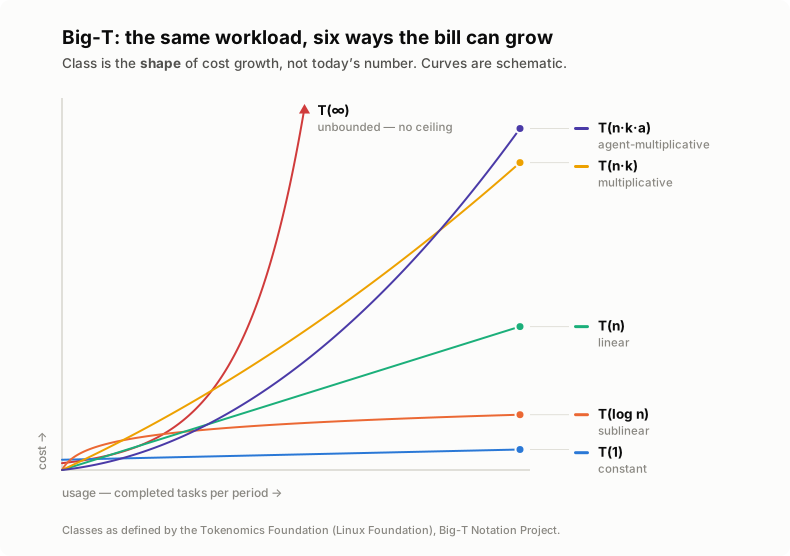
| Class | What’s going on | How the bill grows |
|---|---|---|
| T(1) | A cache answers most requests; the model is rarely called | Barely grows with usage |
| T(log n) | Plain code trims the input before the model sees it, such as retrieval that drops most of the context | Grows slower than usage |
| T(n) | One model call per task; cost tracks the size of the input | Grows with usage, predictably. The healthy default |
| T(n·k) | The system makes k model calls per task: reasoning steps, tool calls, context replayed each turn. k is invisible on the invoice | Usage times k |
| T(n·k·a) | Agents hand work to other agents, so a second multiplier compounds the first. The Foundation calls this “the O(n²) of AI” | Compounds with usage |
| T(∞) | A loop with no exit condition | No ceiling at all |
The multiplier k deserves a moment, because it is larger than most teams assume. In our own demo environment, one system makes a median of 44 model calls for every task it completes, and a single run has gone as high as 54. Its owner sees one finished task. The provider sees 44 unrelated requests. Nothing on the invoice connects the two, which is exactly why the class, not the monthly total, is the early warning. A workload that is comfortable at ten users and ruinous at a thousand didn’t change; it was T(n·k) all along and was budgeted as if it were T(n).
The second number the standard cares about is cost per completed task: total spend divided by the units of work that actually finished. It sounds obvious, and it is the number a finance team can actually use. But no provider can compute it for you, for the same reason: they don’t know where one task ends and the next begins. Only the system orchestrating the work does.
AI economics, tokenomics, FinOps, AI cost control: how the words relate
You hear these terms all the time. These terms are new, and the industry uses them loosely, sometimes as synonyms, sometimes as layers. Exact definitions do not really exist yet (and perhaps never will). Perhaps the most useful way we’ve found to use them is as four levels, from the strategic question at the top to the operational one at the bottom. Each level asks something the others don’t:
| Concept | What it covers | Questions asked | Stakeholders |
|---|---|---|---|
| AI economics Strategic | Value, return, and total cost of AI across the business. | Is this AI worth it? | C-suite, CFO, strategy |
| Tokenomics Measurement | How token consumption becomes cost and value: cost per completed task, growth class (Big-T), cost to serve. | What does finished work cost, and how does that grow? | Head of AI / platform leads, FinOps practitioners, product managers pricing AI |
| AI FinOps Organizational | Allocating spend to owners, forecasting, showback and chargeback, accountability. | Who owns it, and is it forecastable? | Finance, FinOps practitioners, engineering managers |
| AI cost control Operational | Limits and reduction in the request path: budgets, quotas, rate limits, routing, caching, batching. | Does this call happen, and at what price? | AI engineers, platform and DevOps teams, architects |
In practice the four blur into each other: the FinOps Foundation’s framework also covers spending guardrails, and the Tokenomics Foundation counts budgets and model routing as part of tokenomics. What they share matters more than where they differ: all four depend on the same underlying data: a record of every AI call, what it cost, and which task it belonged to. Brutor AI keeps that record once and uses it for all four; see how Brutor AI controls and reduces AI cost.
Each layer needs the others, because each one alone leaves a gap. Spending limits on their own stop the bleeding, but they don’t tell you why it happened. Knowing which team spent the money doesn’t tell you whether next quarter’s bill will be $50,000 or $400,000; that depends on how the workload’s cost grows, which is what tokenomics measures. And measuring without limits means you understand the overrun perfectly, after it has happened. Only when cost is tied to the work it paid for can the top question (is this AI worth it?) be answered at all.
Who tokenomics is for, and why they care
Just because tokenomics is the new buzzword, does not mean that everyone who uses AI needs to worry about it. To some people at your organization though, it is a crucial discipline they need to get right.
The platform or AI lead cares because inference becomes the dominant cost as products scale, and they are the one choosing models, routing, and caching. Big-T tells them which lever works on which workload: a cache moves repeat traffic toward T(1), a cheaper model lowers the price of every T(n) call, a depth limit bounds a. One well-documented trap they can now avoid: a 2026 study found that in roughly a third of model-pair comparisons, the model with the lower list price was actually more expensive in use once hidden reasoning tokens were counted. Cost per task catches that. A price list doesn’t.
The FinOps practitioner cares because they are being asked to forecast something that doesn’t grow in a straight line, with last month’s invoice as the only input. Tokenomics gives them a forecasting model that isn’t the invoice times a guess. Budget on class and volume, revise when a workload changes class, and include agents in chargeback, a real gap today, since 98% of organizations run agentic workloads but only 36% include them in cost reporting. The Foundation is also feeding token telemetry into FOCUS, the open billing-data specification FinOps teams already use.
The CIO cares because they are the one saying yes or no to agentic projects, and the odds are not kind. Gartner expects more than 40% of agentic AI projects to be canceled by 2027, mostly over cost and unclear value, and now advises stress-testing a deployment’s economics against token-price swings before approving it. Cost per completed task is the number that test needs, and when spend spikes, “what class is that workload, and is it justified?” is a much better board answer than a shrug.
The CFO doesn’t need to learn the word, and probably won’t. What they care about is the outcome: a forecast that holds, margins that don’t erode quietly, and a cost figure that attaches to a business result rather than to a pile of API calls. That is what makes ROI arithmetic possible at all.
Product managers selling AI-powered features care because their margin depends on a number they usually don’t have: cost to serve per task, which is what pricing actually needs. In the same survey, 49% of companies had been forced to reprice an AI product and 81% reported an impact on gross margin. Knowing the number before you set the tier beats finding out after the quarter.
Developers mostly want not to be throttled mid-task, and end users don’t care at all, nor should they. Tokenomics is a management discipline. Done well, it is invisible to the people doing the work.
What you can actually do with it
Pulling the threads together, here is what the standard lets you do that a spend report alone never could:
- Pick the right lever per workload (cache, cheaper model, batch, depth limit) and see from the class whether it worked.
- Re-check cost per task every time a model changes, so a “cheaper” model that isn’t gets caught in days, not quarters.
- Put limits where cost compounds (bounded depth and circuit breakers on T(n·k·a) workloads) instead of a flat cap that stops good work as readily as bad.
- Forecast from the growth class, not the last invoice.
- Approve agentic projects on cost per outcome, stress-tested, before they ship.
- Price your own AI products from measured cost to serve, with a margin you chose.
Every one of these needs the same raw material: a record of every model call, tool call, and delegation, grouped by the task it belonged to. That record can only be written by something sitting in the request path while the work happens. Which brings us to Brutor.
Tokenomics on the traffic you route through Brutor AI
Brutor AI FinOps starts from a simple position: don’t just manage AI costs; actively reduce them. For everything you route through the Brutor AI Gateway (your applications, agents, portal users, coding assistants), budgets are enforced before the call, the bill is brought down automatically, and every dollar is attributed to the user, team, agent, model, and tool behind it. Tokenomics is the newest layer on top of that, and the reason Brutor can measure it rather than estimate it comes down to what the gateway already records.
The Tokenomics Foundation describes a five-layer stack, from silicon at the bottom to Layer 5: Routing and Governance at the top: routing, gateway caching, budgets and quotas, and safeguards against unbounded agent behavior. If you know Brutor, that list will sound familiar: it describes what the Brutor AI Gateway does. We didn’t build something new to adopt the standard; the platform was already recording the inputs it needs, for two reasons.
The gateway is in the request path for everything an agent does. Model calls, MCP tool calls, skills, and agent-to-agent delegation all pass through the same enforcement point, so every step of every task is seen, not just the LLM calls. That is where k and a come from: counted, not inferred.
The unit of record is the AI System, and every task is a run. Brutor doesn’t account by API key. It accounts by the thing you deployed (the agent, assistant, or workflow, with its owner and its contract) and records each completed task as a run with its steps, tools, outcome, and cost. Cost per completed task falls straight out of that ledger.
On that foundation, everything in this article runs from one record, for the traffic you route. Limits are enforced before the call: exhaust a token or request quota, or a dollar budget you’ve set to hard-stop, and the request is refused at the gateway before it reaches the provider. Delegation depth is capped, so the agent multiplier has a hard ceiling. The bill shrinks through a semantic cache, prompt caching that the gateway manages and whose savings it meters in dollars, batch processing at provider batch rates across eight providers, and routing to cheaper models: in Big-T terms, the levers that move a workload into a cheaper class. And attribution reaches the user, team, agent, model, and tool behind every dollar.
Tokenomics is what the ledger yields once it exists. Every AI System card in Mission Control now shows three numbers: spend, cost per completed task against the ceiling in the system’s contract (it turns red when it crosses), and the workload class as a chip on the card.
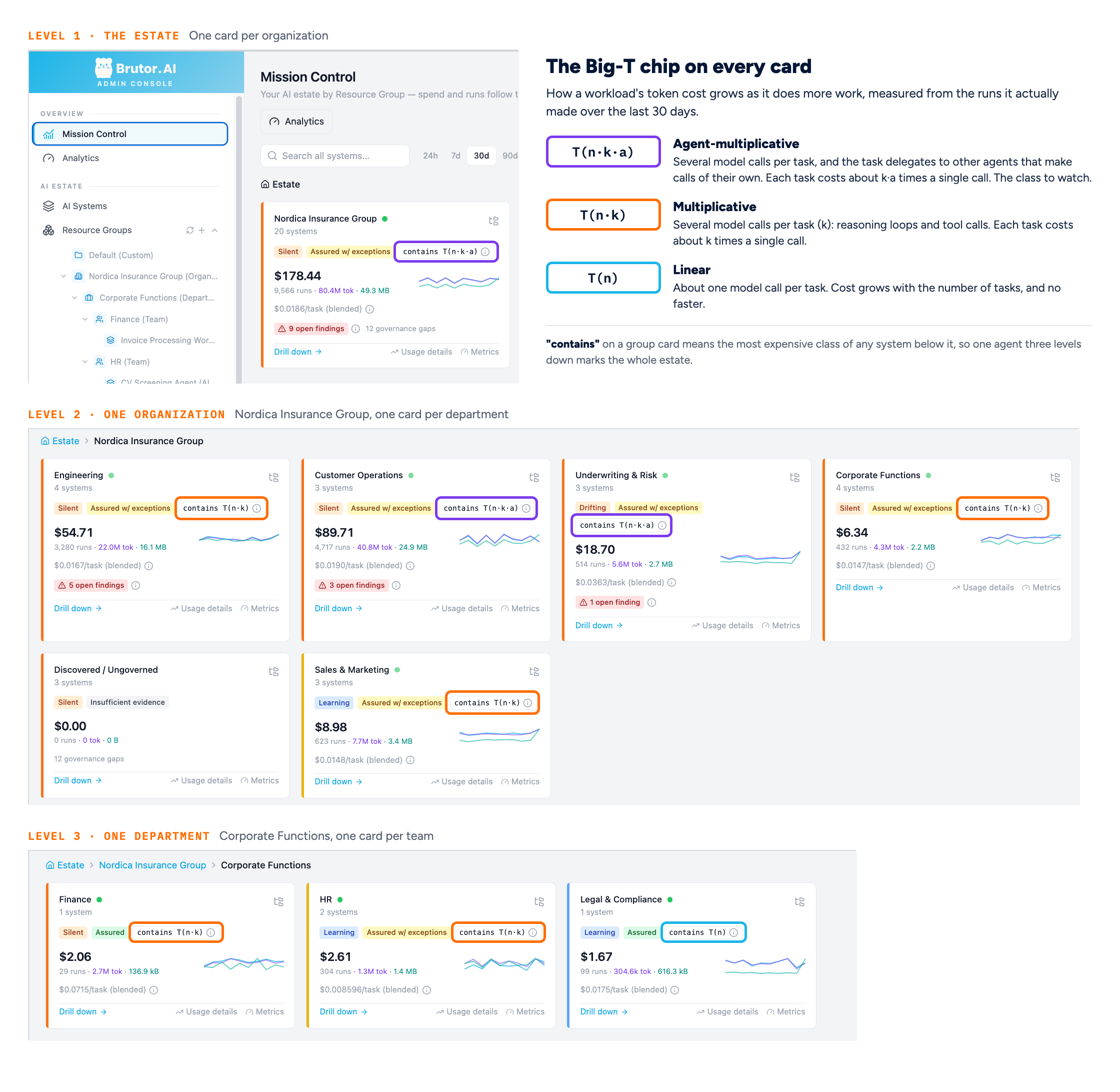
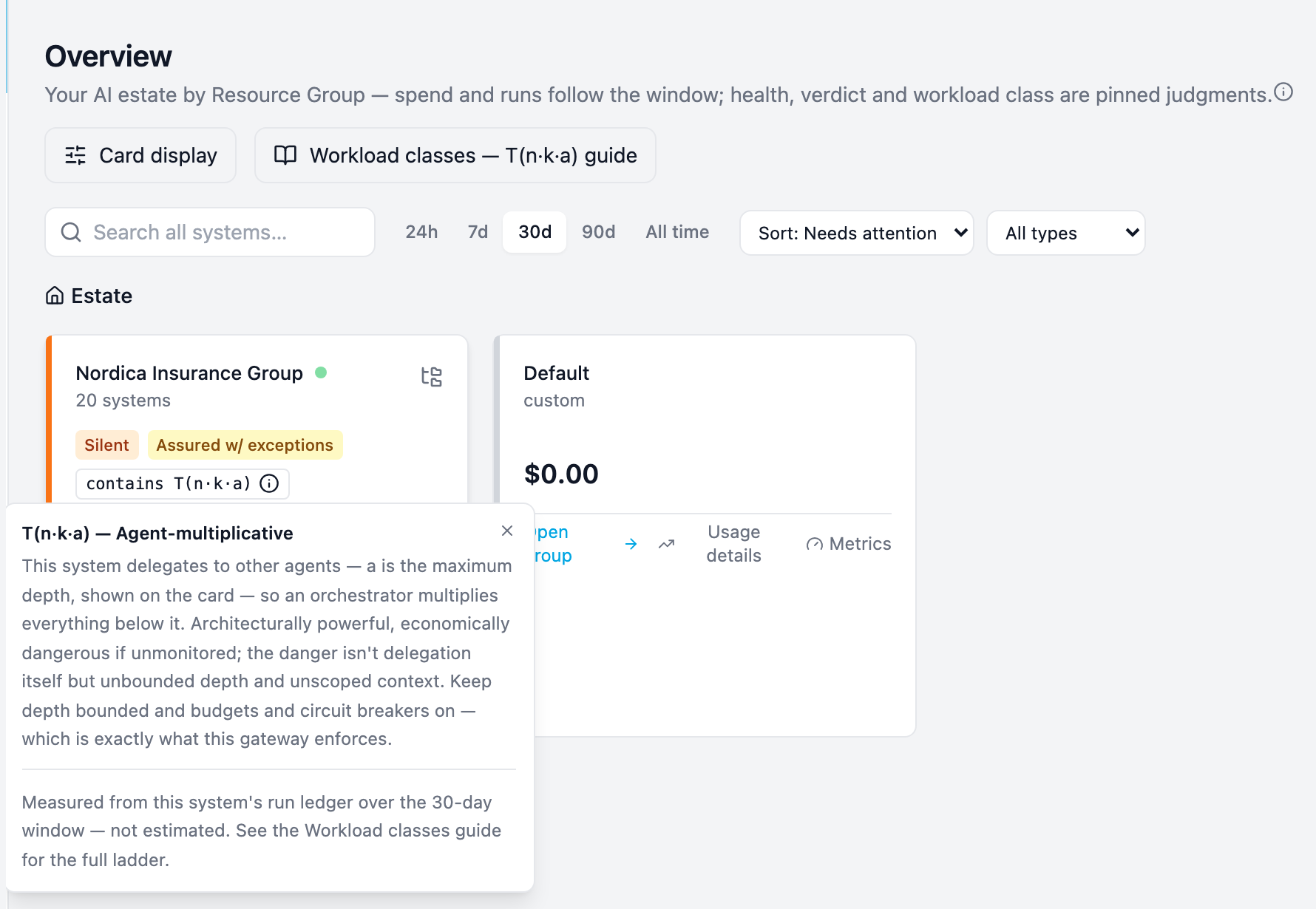
One difference from the standard is worth being clear about. The Foundation assigns a Big-T class by reading a workload’s architecture. Brutor derives it from what actually ran, over the completed runs of the last 30 days: n is the runs themselves, k is the median number of model calls per run, and a is whether runs hand work to other agents (at least one in twenty of them do), with the deepest delegation shown on the card. Brutor assigns four of the six classes this way: T(1), T(n), T(n·k) and T(n·k·a). It never assigns T(log n) or T(∞) from observation; an unbounded loop shows up instead as a run that breaks its limits. When there are fewer than 20 runs to go on, the card shows no class rather than a guess; at the time of writing, 4 of the 20 systems in our own environment show none for that reason. We think a measured class you can trust beats an estimated one you can’t, and we’d rather show a blank than a number we can’t stand behind.
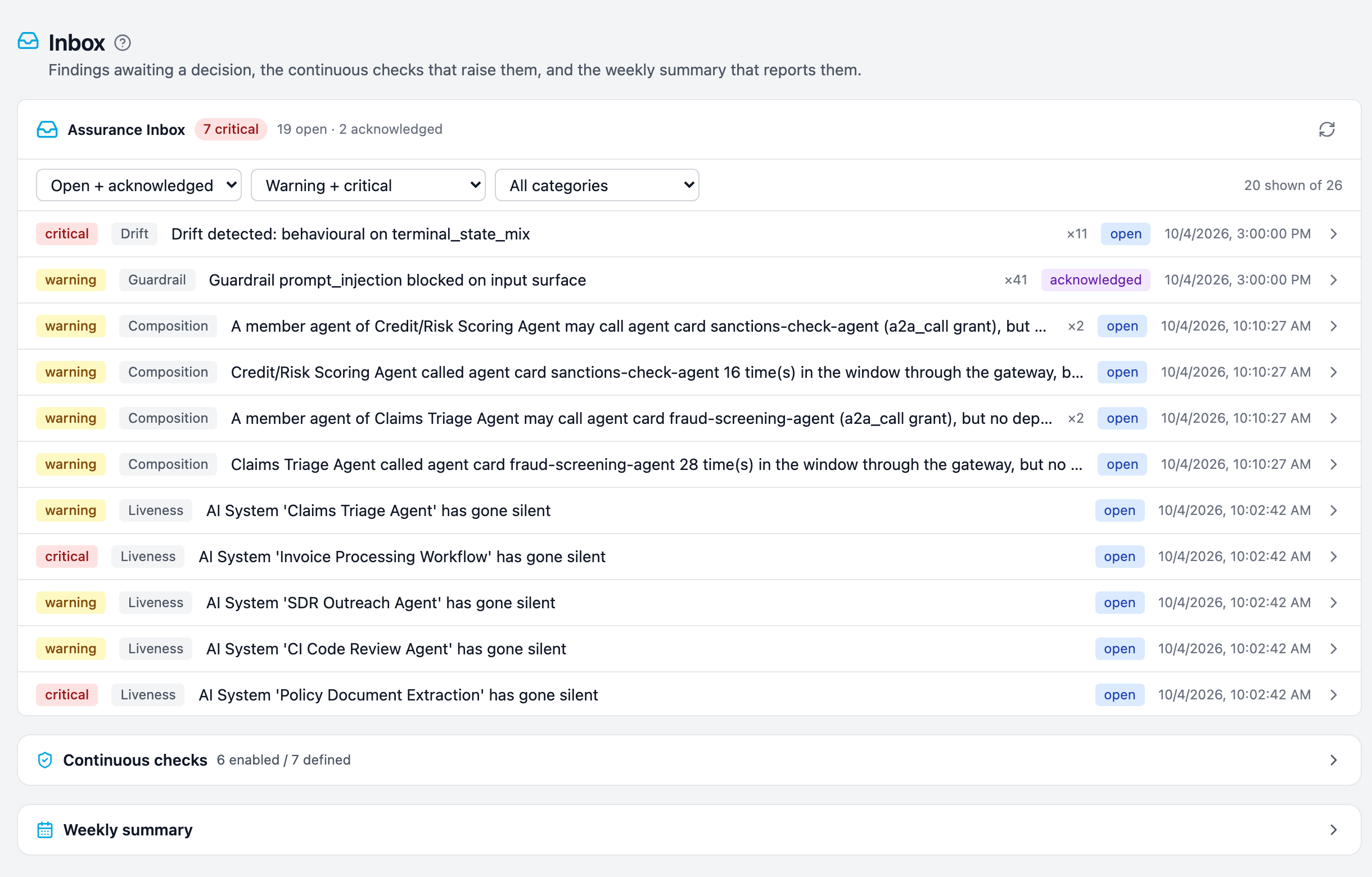
Because the class is recomputed continuously, a change in class becomes a finding. A system drifting from T(n) toward T(n·k) (a provider updated the model, a tool chain grew) shows up as cost-complexity drift, with a candidate cause when Brutor can see one, in the same Inbox as the behavioral drift and liveness findings Brutor already raises about your AI systems. You respond the way you would to any other finding: tighten a limit, change the routing, or accept it and raise the ceiling. Your cost structure becomes something that is watched, like everything else about an AI System.
Two small design choices keep these numbers honest. Health, verdicts, and class are always computed on a fixed 30-day window, whatever time range you pick on the dashboard, so there is no view in which a struggling system looks fine. And groups always show the worst state inside them, never an average; nine healthy systems and one in violation reads “Violations.”
One thing follows from all of this, and it is the practical argument for routing more of your AI through the gateway. Everything above (the limits, the reductions, the class, the cost per task) applies to traffic that routes, because that is where the run ledger comes from. The same ledger also holds the AI you buy rather than route: ChatGPT, Copilot, and Claude usage imported from the vendors’ own analytics, attributed per user and product and labeled as observed, but with no class, because there is no run to measure, and no way to reduce a cost that already happened at the vendor. Shadow AI found by discovery is inventoried with an owner, and its cost is unknown until it routes. What routes can be limited, reduced, and measured; what doesn’t can only be watched. The AI FinOps page covers the bought and observed side, and the shadow AI article covers the routing decision.
That is the whole story, really. The ledger that enforcement writes is the ledger FinOps allocates and tokenomics classifies. Adopting a new discipline didn’t mean adding a new product, because the evidence was already there, a by-product of the control you wanted in the first place.
Where to start
Take your three most important AI workloads and ask three questions. If this runs away, what stops it? What does a completed task cost, and which class is it? Which lever would move it into a cheaper class? If the second and third can’t be answered from what you have today, that is precisely the gap the new standard exists to name. The Brutor AI Control Plane trial is available as a free download, and we’re happy to walk through the measurement on your own workloads in a 30-minute session.
Sources: Tokenomics Foundation (Linux Foundation): definitions, the Five-Layer Tokenomics Stack, Big-T notation and the “O(n²) of AI” characterization · Linux Foundation launch announcement, August 4, 2026 · Fortune, August 4, 2026 · CIO Dive on the FinOps X announcement · Gartner, August 17, 2026 (inference cost per agentic workflow to rise more than fivefold through 2028; agents need 5–30× more tokens per task than a chatbot) · Gartner, June 25, 2025 (over 40% of agentic AI projects canceled by 2027) · Gartner, AI Tokenomics: Measuring LLM Usage in AI-Enabled Applications · 2026 State of AI Cost Governance, Mavvrik & Benchmarkit, 396 organizations (62% / 40% / 33% / 25%; 11% forecast within ±10%; 98% run agents, 36% report them; 49% repriced; 81% margin impact) · FinOps Foundation, State of FinOps 2026 (98% of practitioners manage AI spend, up from 31% in 2024) · Chen, Stoica, Zaharia, Zou et al., The Price Reversal Phenomenon, arXiv 2026 · Brutor AI Mission Control screenshots: our own demo environment.