Your organization wants to scale AI. Your agents are multiplying. Your compliance team is asking questions. And the gap between what AI can do and what you can govern is widening fast. Here’s what AI governance actually means now — and what to do about it.

Three numbers tell the story of enterprise AI right now.
75% of companies plan to deploy AI agents by the end of 2026. 21% have a mature governance model to manage them. And 40% of agentic AI projects could be canceled by 2027 due to escalating costs, unclear business value, or inadequate risk controls.
That gap — between ambition and control — is the defining challenge. Gartner has named AI Governance Platforms one of the top infrastructure trends of 2026. Deloitte calls governance “the difference between scaling successfully and stalling out.” The organizations that close the gap first will scale AI confidently. Those that don’t will stall.
How AI Governance Has Changed
AI governance used to mean ethics committees, bias detection, and policies about which tools employees could use. That was enough when AI was a chatbot answering questions.
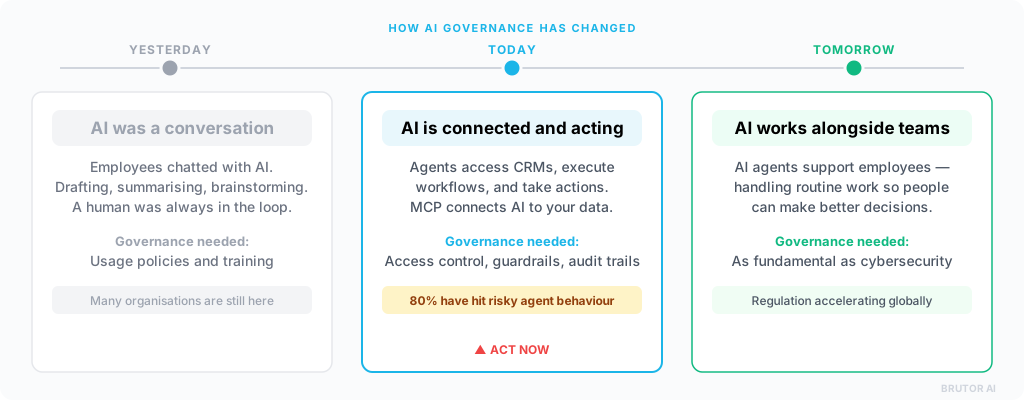
It’s not enough anymore. The scope has shifted — from managing what AI says to controlling what AI does. Three changes are driving this shift — and most organizations sit somewhere along this spectrum. The question is whether your governance is keeping pace with where you’re heading.
Yesterday — and still today for many organizations: AI was a conversation. Employees chatted with AI — drafting emails, summarizing documents, brainstorming. The risk was limited. If something went wrong, a human was always in the loop. Many organizations are still primarily at this stage — and that’s fine, provided the next stages are on the radar.
Today: AI is connected and acting. The Model Context Protocol (MCP) has become an industry standard for connecting AI to enterprise systems — CRMs, code repositories, communication tools. Every major platform supports it. AI agents can now access your data, execute workflows, and take actions autonomously. And they’re increasingly likely to act in ways their operators didn’t intend. As McKinsey’s Rich Isenberg puts it: “If an agent is going to be accessing tools or data, it should be going through an MCP gateway.”
Meanwhile, there’s an active debate about whether MCP is even the right abstraction for every use case — some agents work better with direct API calls or CLI tools. What’s not debatable: regardless of which protocol agents use, the governance challenge is the same. A governance platform needs to be protocol-agnostic.
Tomorrow: AI works alongside your teams. The longer-term trajectory points toward AI agents that support employees across departments — handling routine analysis, monitoring systems, and preparing information so people can make better decisions faster. The future is uncertain, but the direction is clear — Forrester anticipates enterprise platforms will manage AI agents alongside human teams, and regulation is accelerating globally (the EU AI Act becomes enforceable for high-risk systems on 2 August 2026, with penalties up to 7% of global annual revenue, and similar frameworks are emerging worldwide).
But you don’t need to wait for tomorrow to act. The governance gaps that matter most — access control, guardrails, cost visibility, and audit trails — are gaps that exist right now, at the “today” stage. Getting these right today means your people and your AI agents can work together productively — and safely.
Why Traditional Approaches Aren’t Enough
Most organizations are trying to govern AI with tools that weren’t designed for it.
Traditional GRC platforms handle risk registers and compliance checklists — essential capabilities, but most weren’t designed for real-time AI governance. Inspecting what an AI agent is doing as it happens, enforcing guardrails before a prompt reaches a model, or tracking which tools an agent called — these require a different kind of infrastructure. The GRC industry is evolving to address this, but as Gartner puts it, traditional GRC tools “are simply not equipped to handle the unique risks of AI.” The gap between what’s needed and what’s available remains significant.
Vendor-specific admin consoles provide meaningful control within their own ecosystem — and for organizations fully committed to a single provider, that may be sufficient. But for organizations using models from multiple providers — and most will, over time — governance fragments: different dashboards, different audit trails, no unified view.
Policies and training are essential — they set expectations and build awareness. But on their own, they can’t enforce compliance at the speed AI operates. Research from Microsoft and LinkedIn shows that 78% of AI users are bringing their own tools to work despite existing policies. The most effective approach combines clear policies with technical enforcement — which is where governance platforms come in.
What the Analysts Say
The research from Gartner, McKinsey, and Deloitte converges on four points.
Governance maturity is the differentiator — not model sophistication. McKinsey’s research shows high-performing organizations are three times more likely to successfully scale agents than their peers. The differentiator isn’t which AI model they use — it’s their governance maturity and willingness to redesign workflows. Organizations that treat agents as productivity add-ons consistently fail to scale.
The challenge has shifted — from what AI says to what AI does. McKinsey’s AI Trust Maturity Survey added “agentic AI governance” as an entirely new dimension to their maturity framework, reflecting a fundamental shift in what governance means. As they put it: organizations can no longer concern themselves only with AI systems saying the wrong thing — they must contend with systems doing the wrong thing. Yet only a third of organizations score above foundational maturity in this area.
Governance investment correlates directly with AI success. Gartner has data from two angles on this. A survey of 360 organizations found those who deployed AI governance platforms were 3.4 times more likely to achieve high effectiveness in AI governance than those who didn’t. And a more recent global survey of 353 data & analytics leaders found organizations with successful AI initiatives invest up to four times more (as a percentage of revenue) in data quality, governance, and AI-ready talent than their peers. Only 39% of tech leaders are confident their current AI investments will positively affect financial performance. Governance is no longer the cost center — it’s the differentiator.
Half of agent failures will be governance failures. Gartner predicts that by 2030, 50% of AI agent deployment failures will be due to insufficient governance platform runtime enforcement. In the near term, ungoverned decisions using LLMs will cause financial or reputational loss.
Enforcement has begun — even before the deadline. The EU AI Office has opened its first formal Article 51 inquiry into frontier general-purpose AI providers — months ahead of the August 2026 enforcement date for high-risk obligations. On the U.S. side, NIST released a concept note for an AI Risk Management Framework profile covering critical infrastructure, and state-level enforcement is moving fast while federal policy stalls. The “regulators are coming” story is now “regulators are acting.”
What a Governance Platform Needs to Deliver
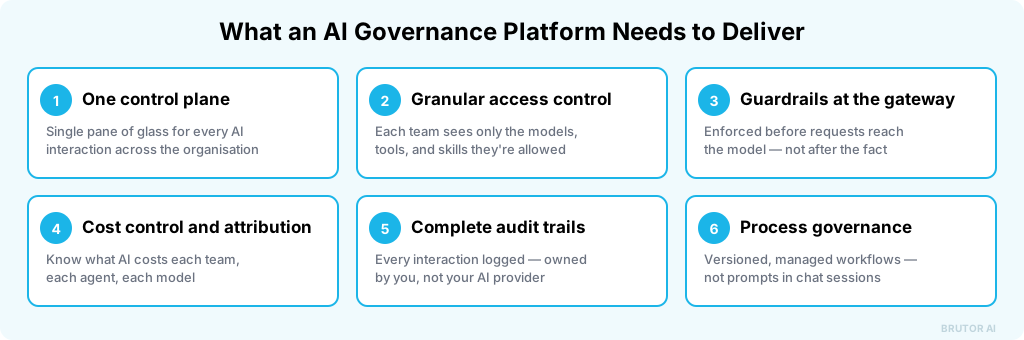
Based on what the analysts describe and what enterprise deployments require, a mature AI governance platform needs to cover six areas. Not every organization will need all six on day one — but understanding the full picture helps you plan the journey and avoid costly retrofitting later.
1. One control plane for all AI traffic. Every AI interaction — users, agents, applications — should flow through a single governance layer. A single pane of glass. Fragmented governance across multiple vendor consoles is not governance at scale.
2. Granular access control. Resource group isolation with role-based access at the model, tool, and skill level. Marketing queries the CRM; Engineering queries GitHub. Each team sees only what they’re authorised to use.
3. Guardrails enforced before requests reach the model. PII detection and masking, prompt injection blocking, content filtering — enforced at the gateway, not after the fact. Security without compromise, baked in from day one.
4. Cost control and attribution. Budgets per team, per agent, per model. Token-level tracking and automatic blocking when limits are exceeded. The CFO sees exactly what AI costs each department.
5. Complete, organization-controlled audit trails. Every prompt, response, tool call, and agent action — logged with full bodies. Owned by your organization, not your AI provider. This is what the EU AI Act requires.
6. A way to capture and govern organizational processes. AI agents need clear, step-by-step instructions to perform enterprise tasks reliably. Define, version, and manage your organization’s workflows as governed capabilities — not as undocumented prompts scattered across chat sessions.
How Brutor AI Platform Addresses This
Brutor AI Platform is a single control plane for the AI your organization routes through it. Whether the traffic comes from users chatting in the Portal, agents running workflows via API keys, or applications calling models, everything flows through the Brutor AI Gateway.









Sources: Gartner — Top Strategic Technology Trends 2026; Market Guide for AI Governance Platforms; Top Predictions for D&A 2026; AI Governance Platform Effectiveness Survey (Q2 2025); Press release on AI investment foundations (16 April 2026) · McKinsey — AI Trust Maturity Survey (March 2026); State of AI Trust 2026: Shifting to the Agentic Era (May 2026) · Deloitte — State of AI in the Enterprise, 2026 · Forrester — Agentic AI Governance and Readiness · EU AI Act — Regulation (EU) 2024/1689; EU AI Office Article 51 inquiries (spring 2026) · NIST — AI RMF Critical Infrastructure Profile concept note (April 2026) · IBM — Cost of a Data Breach Report 2025