
The Complete AI Control Plane
One platform to govern, secure, and deliver enterprise AI — from the enforcement point to the end user.
- Every major AI provider out of the box
- MCP-native from day one
- Govern what you build — see & cost what you buy
- Agent skills management
- On-prem, private cloud, or Brutor SaaS
Most AI gateways govern requests. Brutor governs the AI system — models, tools, skills, agents, and knowledge — as one policy surface, with a group hierarchy that maps to how you actually organize.
Adoption is racing ahead. Governance isn’t keeping up.
of organizations have deployed AI agents in the past year.
Deloitte · State of AI in the Enterprise 2026has a mature governance model for those agents.
Deloitte 2026added to average breach cost when shadow AI is involved.
IBM · Cost of a Data Breach Report 2025A complete AI governance system — built around how teams actually work.
Govern every AI request.
Route, secure, and audit all AI traffic — LLMs, MCP servers, autonomous agents — through the Brutor AI Gateway: the platform’s high-performance Rust enforcement engine.
Explore the Gateway →An AI workspace teams actually use.
The Portal is where AI does real work on your data — multi-model, connected to your systems and knowledge, running the agent skills your teams built. Governed by default, so the sanctioned path is also the easiest one.
Explore the Portal →Build governed agents fast.
OpenAI-compatible endpoint, native MCP, native A2A v1.0, governed Agent Skills over MCP — drop-in primitives for the agents your teams ship.
Developer Corner →Everything you need — from the first setup to every day in production.
Brutor carries you through each phase, with everything you need already in the box.
Start governed from day one.
You define your organization’s structure, pick your models, set guardrails, and load your knowledge. Brutor gives you everything you need already in the box.
- Every major provider, preconfigured across an expanding catalog — OpenAI, Anthropic, Google, Azure, Mistral, and self-hosted via Ollama / vLLM / KServe.
- A curated catalog of MCP servers, one-click enable. GitHub, HubSpot, Snowflake, Atlassian, Tableau, Postgres, Grafana, and more.
- Resource Groups mirror your real org — teams, departments, cost centers, projects — from day one.
- Guardrails enabled by default on every surface that runs through Brutor — input, streaming output, tool calls, and agent traffic: ML-based PII detection and masking, prompt-injection and jailbreak filtering, secrets detection, toxic-content filtering.
- Knowledge Base RAG built in: upload PDFs, Office documents, and markdown — or sync straight from Confluence, Notion, Google Drive, Slack, GitHub, Jira, and SharePoint. Per-group isolation. Source citation on every answer.
Tune, monitor, and iterate — in the tools you already use.
Teams use AI. You watch costs, adjust behavior per department, iterate on policies. Brutor plugs into the observability stack you already run.
- Mission Control dashboards — usage, cost, latency, cache hit rates, model health.
- Per-group cost attribution for FinOps: which team, which agent, which project spent what — including the AI you buy, with vendor usage imported from Anthropic, OpenAI, Google, and Microsoft consoles.
- Fine-tune per group — Engineering and Marketing each get the models, temperature, and hallucination settings that fit their work.
- Two-layer cache saves tokens automatically: Redis for exact-match lookups, Qdrant for semantic similarity.
- Open observability — native OpenTelemetry hooks plug into Prometheus, Grafana, Loki, or any OTel backend you already run.
Run agents and high-volume traffic without drama.
Brutor handles the operational realities — rate limits, failures, approvals, compliance — so agents stay under control at production volume.
- Agent Skills with human-in-the-loop approval (optional or enforced) — see the Built for agents section below.
- Policy-as-code: export a resource group’s full config, edit, re-apply as a versioned policy with every deploy.
- <5ms governance overhead. Rust core on Axum + Tokio. Every request logged, cached, routed, and checked in under 5 ms.
- Production-stable: circuit breakers per model and MCP server, configurable fallback chains, graceful rate-limit handling, horizontal scaling, retry with exponential backoff.
- Compliance evidence for EU AI Act, ISO/IEC 42001, HIPAA, SOC 2, and GDPR Article 30 — generated automatically when a control fires; detailed in the Compliance section.
Shaped to your organization, not a generic template.
Most AI governance tools hand you a one-size-fits-all structure. Brutor does the opposite: you define your organization once — teams, departments, cost centers, projects — and governance flows automatically through every level.
Define once.
Your real org chart becomes the governance model. Model it the way you actually operate.
Two layers of inheritance — not one.
Most tools blur governance and tooling into a single setting. Brutor separates them on purpose:
No forced rewrites.
Reorganize your teams? Policies follow. Move a department under a new parent? Budgets, guardrails, and audit boundaries recalculate automatically. No re-templating. No re-binding.
AI spend FinOps actually appreciates.
Token costs scale fast. Brutor caps what shouldn’t ship — and shrinks the bills that do. Per-team budgets prevent surprise invoices; semantic cache, batch processing, and smart routing typically cut what remains by 50–70%. And it prices the AI you buy, not just the AI you build — vendor usage imports from Anthropic, OpenAI, Google, and Microsoft consoles bring closed-app spend into the same dashboards. Predictable AND smaller.
Per-group token budgets
Hard caps and soft alerts at the resource group level. Marketing’s monthly limit, Engineering’s monthly limit — all in one place.
Smart model routing
Route each task to the cheapest model that meets policy. Cheap fast models handle routine work; premium tiers reserved for queries that actually need them. Typically 30%+ savings.
Two-layer cache
Response cache for exact-match prompts, semantic cache for near-identical ones. Both return cached responses — no token spend, no provider call. Typically 20–40% off token spend on real workloads.
Rate limits & quotas
Per-user, per-group, per-tool. Prevent runaway agents from running up bills, stop scripted misuse, keep the budget in your control.
Batch processing
Push large workloads through Brutor’s batch lane — up to 50% lower cost than real-time on supported providers. Ideal for evaluations, document pipelines, and bulk classification.
Lineage on every dollar
Tie every cost back to the prompt, the agent, the tool call, and the user behind it — for finance forecasting and audit.
Built for agents — from day one.
Brutor treats every agent action — prompts, tool calls, inter-agent messages — as a governed event, and every agent as a first-class identity on your IdP with per-action permissions: allow, deny, or approval-required. Default-deny.
Agent Skills
Encode your business logic as Skills — versioned, scoped to a resource group, served over MCP with progressive disclosure, and executed only in Brutor’s sandbox. The bundle never leaves the platform; every step is audited.
Human-in-the-loop
Three states per tool — enabled, approval-required, disabled. Pending queue for reviewers, runtime enforcement at the Gateway.
Agent-to-Agent (A2A)
Native A2A v1.0 — signed agent cards, HMAC delegation, inbound and outbound traffic governed through the same Gateway.

Compliance evidence, generated automatically.
“Every prompt → every model → every tool → every answer. One connected lineage.”
- Full decision lineage. From the user’s prompt, to the model that answered, to every tool the agent invoked, to the final response — one connected trace for every interaction. Filterable by user, group, model, server, and date range.
- Proxy logs with full request/response bodies, filterable by user, group, model, server, and date range.
- Drill-down from high-level summaries to individual interaction detail.
- EU AI Act evidence — Article 9 risk management through enforced policies, Article 12 traceability with log retention — tagged automatically when a control fires.
- ISO/IEC 42001 support — a first-class “AI System” object, live Annex A control coverage, and per-asset fact sheets you can snapshot as immutable audit evidence.
- Framework-tagged evidence for HIPAA, SOC 2, and GDPR Article 30 — written the moment a guardrail blocks, a rate-limit hits, or a policy denies. Auditable evidence, not assurances.
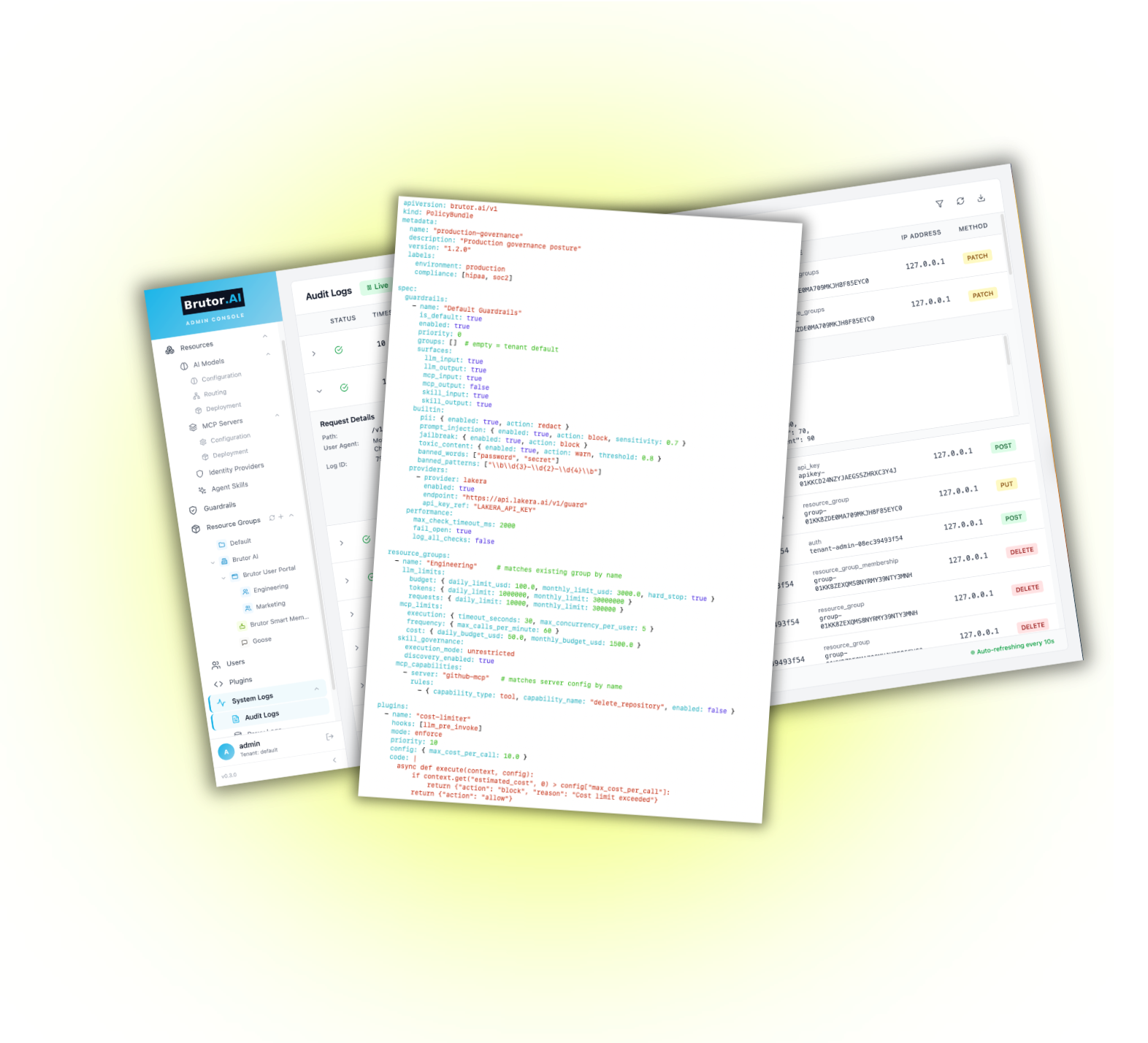
Policy-as-code.
Export any resource group’s complete configuration as versioned, reviewable policy-as-code. Edit, review, re-apply on any deploy. Governance that ships with your code — not a policy document that drifts.
One governed layer between your users and the AI you run.
Every prompt, every model call, every tool invocation, every agent message flows through the same layer — observable, controllable, attributable. The Brutor AI Gateway as the enforcement engine; LLMs, MCP servers, A2A peers, agent skills, and the knowledge base as the resources it governs.
Explore architecture
The full enterprise pipeline. No detectable latency cost at tested concurrency.
Rust proxy with guardrails, RBAC, audit, semantic cache, and KB retrieval — all of it on. P50 and P99 latency match the bare endpoint.
Read the benchmark →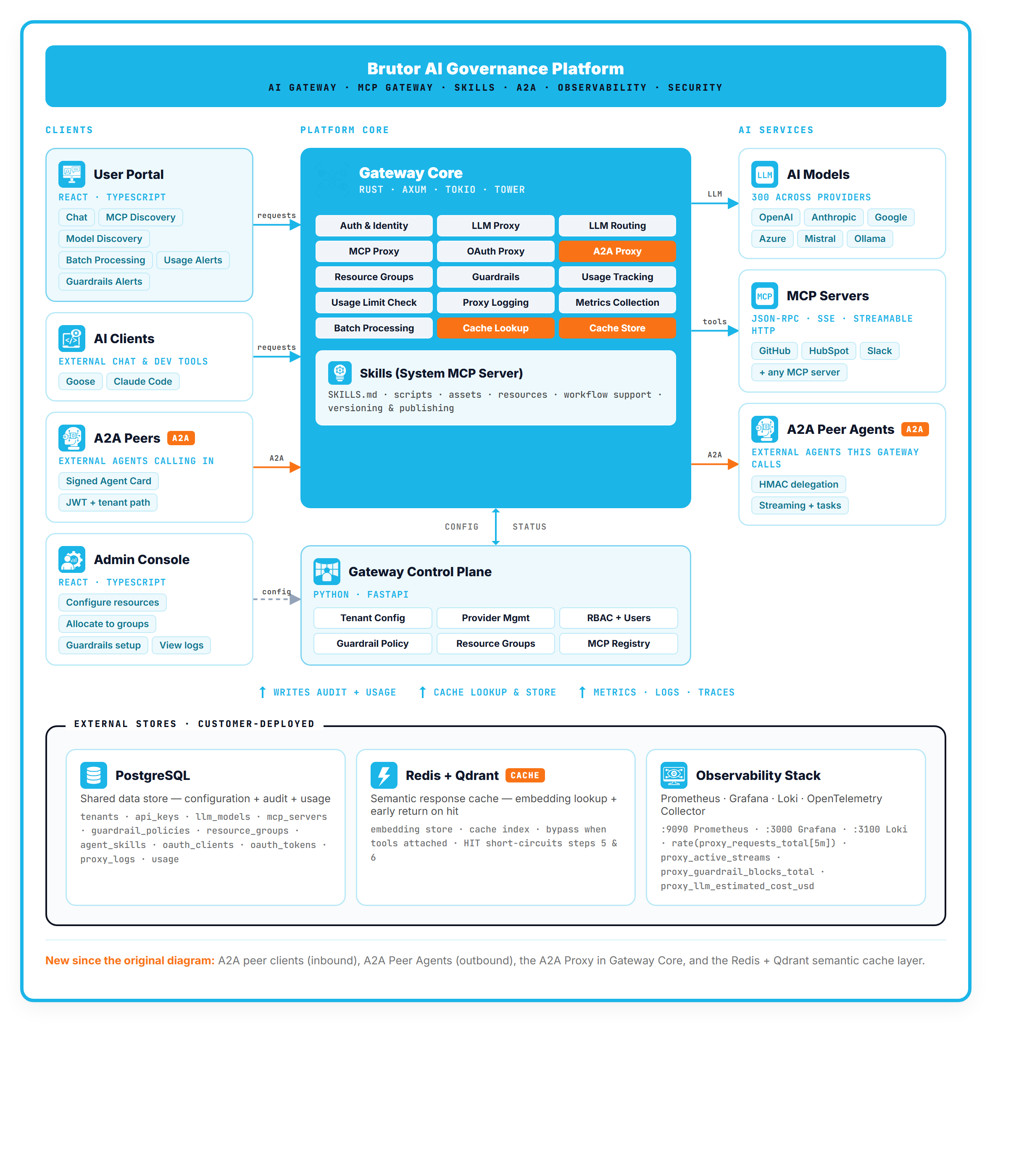
AI is everywhere in your organization — your control over it will be too.
Download the free trial, or book a 30-minute demo with our team.